Your students have changed. What about the way you support their learning?
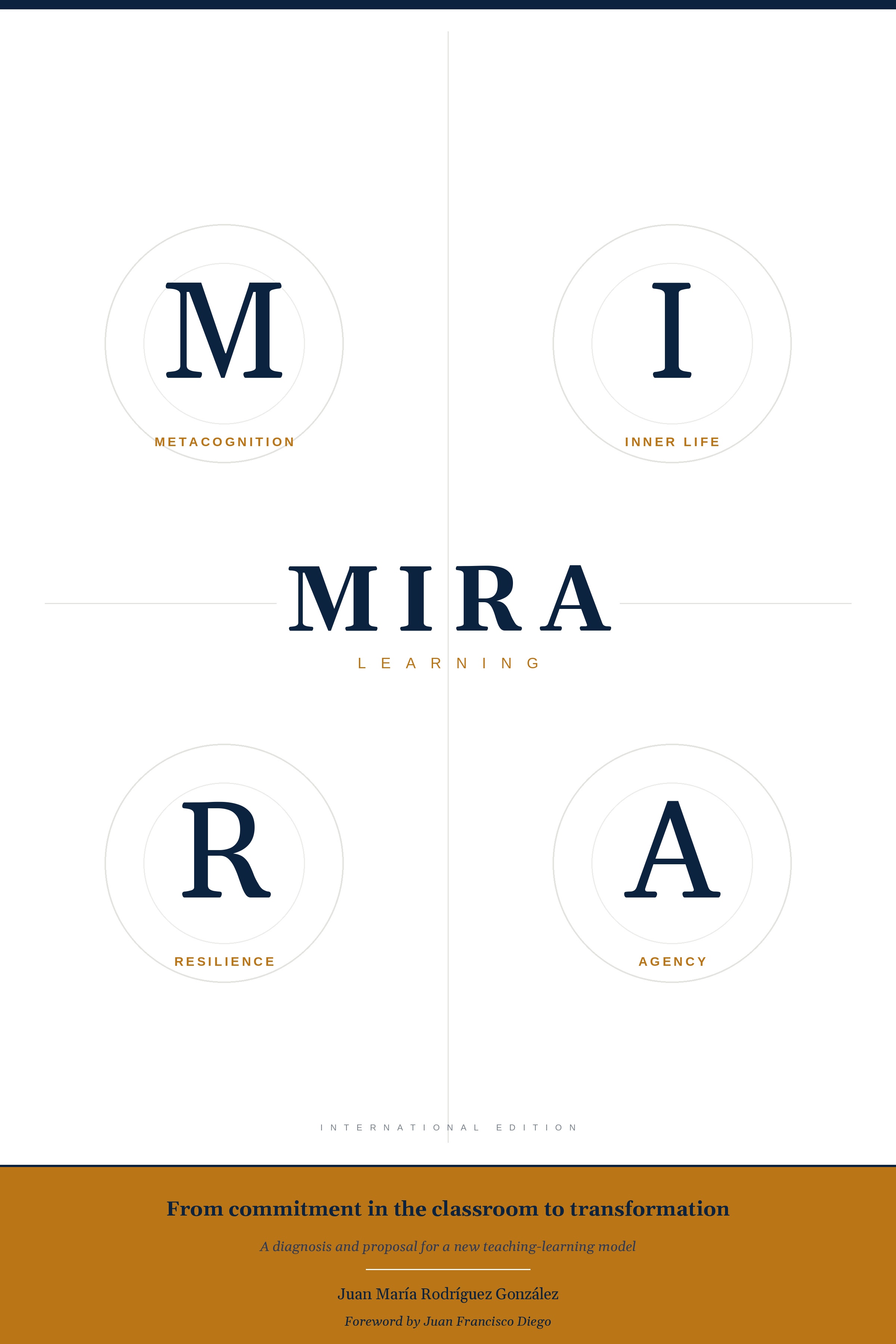
MIRA —Metacognition, Inner life, Resilience and Agency— is the teaching-learning model that turns those four conditions for deep learning into verifiable instruments. It works in any subject, at any year group, with any methodology you already use. No external accreditation. No spatial overhaul.
Your students assess their own work before handing it in. You receive that reflection before marking. That changes the feedback — and it changes the learning.
Most teachers sense that something has changed in recent years. Not in the content or the curricula — in the students. More difficulty sustaining effort, greater sensitivity to error, less capacity to project themselves into the future. Research has a name for this pattern: the Functional School Maturity Gap (DMEF).
①
Digital immediacy
How it shows in the student
Difficulty sustaining prolonged effort. A search for instant gratification. Low tolerance of boredom and uncertainty.
Blocks Agency: a student cannot act with sustained autonomy if they cannot tolerate delay.
②
Family overprotection
How it shows in the student
Avoidance of error and failure. Students arrive in the classroom without having learnt to manage difficulty or to make decisions with real consequences.
Blocks Resilience and Agency: without the experience of managed error, a student cannot become a changemaker.
③
Low tolerance of failure
How it shows in the student
Error is experienced as a threat to identity rather than as information. Frustration leads to giving up, not to revising the strategy.
Blocks Metacognition: a student who avoids error cannot reflect on their own process.
④
Absence of meaning
How it shows in the student
Lack of motivation, emotional disengagement from learning. Only 20% of adolescents have a clear purpose that guides their decisions (Damon, Stanford, 2008).
Blocks Inner life: without a connection between knowledge and one’s own life, learning does not take root.
MIRA’s response — four conditions acting on the four factors simultaneously
M
Metacognition
① Immediacy③ Failure
I
Inner life
④ Meaning② Overprotect.
R
Resilience
② Overprotect.③ Failure
A
Agency
① Immediacy④ Meaning
The map shows each condition’s main response, not an exclusive relationship. In practice the four conditions act on all four factors simultaneously, with differing intensity: Metacognition trains the attention that immediacy erodes, but it also builds the self-knowledge that an absence of meaning demands. That multiple influence — not a one-to-one correspondence — is the core of the design.
DMEF, the key concept underpinning the model
The Functional School Maturity Gap (DMEF) is not a developmental disorder or a clinical condition. It is an acquired pattern of functioning: a set of cognitive, emotional and behavioural difficulties that emerge as an adaptive response to an environment of permanent immediacy — digital and familial — and that show up specifically in the school context.
The DMEF does not describe what a student is, but how they function in response to the conditions in which they have grown up. What the environment has produced, the environment can change.
MIRA defines the conditions a student needs in order to learn deeply and durably, and how the teacher can verify that those conditions are being met.
M
Metacognition
The student knows their own learning process
Self-assessment happens before, during and after every task.
d = 1.33 · Hattie & Timperley, 2007
I
Inner life
The student connects knowledge with their own life
Without that connection, learning stays superficial and does not transfer.
Intrinsic motivation · Deci & Ryan, 2000
R
Resilience
The student treats error as information, not as failure
Desirable difficulty is an ingredient of the design. The teacher plans for it.
d = 0.73 · Hattie & Timperley, 2007
A
Agency
The student produces something real with consequences beyond the classroom
Without authentic production there is no real evidence of learning.
d = 0.92 · Bandura, 1997
Empirical foundation
What the research says
Some of the highest effect sizes documented in education correspond to what MIRA activates. Hattie’s meta-analyses: 1,800 studies, 250 million students.
d=0.92
Student agency and self-efficacy
Bandura, 1997 · Condition A
d=1.33
Student self-assessment
Hattie & Timperley, 2007 · Condition M
d=0.73
Feedback on the process
Hattie & Timperley, 2007 · Condition R
d=0.69
Metacognitive strategies
Flavell, 1979 · Condition M
d=0.47
Academic self-concept
Immordino-Yang, 2015 · Condition I
d=0.40
Average effect. Reference threshold
Hattie, 2009
The effects of conditions M and A double or triple the d=0.40 threshold. The detailed comparison with other models is in the next section.
Publications
The documentary base of the model
MIRA’s documentary base, ordered from the most accessible to the most academic. All material is open access.
1 · Founding article · the way in
Why a new teaching-learning model
The text that diagnoses the DMEF and underpins MIRA. The best starting point for understanding the model.
The complete work: the diagnosis, the four conditions, the assessment system and implementation, developed in depth. The extended companion to this site.
The Observatory brings together the most recent data from the major international assessments —PISA, PIRLS, TIMSS and the European Commission's Education and Training Monitor— read side by side across the United States, the EU and the OECD as a whole. The goal isn't to rank systems against one another, but to check whether the same direction of travel shows up regardless of which reference point you examine — which is exactly what the Functional School Maturity Gap (DMEF) predicts.
Last updated: June 2026
The latest available data
Study
What it measures
United States
EU
OECD / International
PISA 2022 OECD · age 15
Maths · Reading · Science
465↓ · 504→ · 499→
474↓ · 475↓ · 484→
472↓ · 476↓ · 485→
PIRLS 2021 IEA · Grade 4
Reading comprehension
548→*
528↓
533↓
TIMSS 2023 IEA · Grade 4
Maths · Science
517↓ · 532→
—
503↓ · 494→ (international avg.)
E&T Monitor 2025 European Commission
Early leaving and basic skills
—
Early leaving 9.4%↓ · target <9% by 2030
Underachievement at record highs (reading 26%, maths 30%)↓
One direction, three reference systems
What the three systems share
The decline in basic skills — reading and maths — predates the pandemic in the US, the EU and the OECD alike.
Mathematics is consistently the weakest competence and the one that generates the most student anxiety, regardless of the system examined.
Socioeconomic status remains the strongest predictor of outcomes in every system with data available.
Underachievement is at or near record highs across Western reference points at the same time.
The pattern repeats across the West's three reference systems: stagnation or decline, more pronounced in mathematics, regardless of which reference point is examined — the decline began before the pandemic in every case. This is exactly the kind of cross-border evidence the Functional School Maturity Gap (DMEF) is built to explain: not a problem specific to one country's curriculum, but a shared shift in the conditions students bring to the classroom.
What the MIRA approach offers
What the data show
What MIRA offers
Decline in thinking and basic skills
Metacognition and Resilience train the "thinking muscle" that immediacy wastes away.
Disengagement and anxiety, especially in maths
Inner life connects learning with meaning; assessment without a "fail" mark reduces the fear of error.
Early leaving still high
The SAT (tutorial monitoring layer) detects early signals in the first two years of secondary, before the problem becomes individual.
Inequity linked to socioeconomic status
Public criteria and evidence-based assessment; the SAT thresholds adjust to context without lowering expectations.
Results that do not improve despite a good climate
Agency gives meaning and sustains effort through authentic production with real impact.
*For PIRLS 2021, the United States assessed Grade 5 rather than Grade 4 owing to pandemic-related scheduling; figures remain comparable in scale but not in exact grade level. Sources: PISA 2022 (OECD); PIRLS 2021 (IEA / NCES); TIMSS 2023 (IEA / NCES); Education and Training Monitor 2025 (European Commission). The latest published edition of each study is used. Forthcoming editions: PISA 2025 (late 2026), PIRLS 2026, TIMSS 2027, and the annual edition of the Monitor.
Reference framework
MIRA and other teaching-learning models
A comparison of models that comprehensively define how the learning experience is organised.
Model dimension
MIRA
IB
Big Picture
Reggio
Montessori
Learn. Comm.
Explicit, assessable exit profile
◑
◑
◑
Student self-assessment as a central instrument
◑
◑
—
—
Personal dimension as a pedagogical condition
◑
◑
Resilience as an explicit assessable dimension
◑
◑
—
◑
—
Genuine agency: authentic production
No external accreditation or spatial overhaul
—
◑
—
—
◑
Compatible with competency-based curricula without adaptation
—
◑
◑
✓ Yes, explicitly · ◑ Partial · — Not a central part of the model
IB · International Baccalaureate
IBO · Since 1968
A complete pedagogical framework with a Learner Profile and criterion-referenced assessment instruments. A benchmark in authentic assessment.
◑ Requires costly accreditation · Resilience and Inner life implicit
Big Picture Learning
Big Picture Learning · US · Since 1995
A network present in a dozen-plus countries, strong in personalisation and whole-person education through real-world internships. At Secondary level, requires replacing the subject timetable with an open one and sustaining a network of external mentor sites.
✓ Personal dimension · Real-world agency
◑ Significant timetable and staffing overhaul · Self-assessment not systematised
Reggio Emilia
Loris Malaguzzi · Italy · Since 1945
A philosophy centred on listening to the child. Very rich in Inner life and Agency. Natural in the early years.
✓ Deep inner life · Expressive agency
◑ No formal 3-18 progression · No instruments for secondary
Montessori
María Montessori · Italy · Since 1907
Strong in autonomy and self-assessment. Requires specialist training and a prepared environment.
✓ Autonomy and self-assessment · Respect for individual pace
◑ Requires specific training · Hard to integrate with competency-based curricula
Learning Communities
CREA · University of Barcelona · Since 1978
A whole-school transformation model based on community participation. Actions backed by scientific evidence.
✓ Community agency · Equity · Empirical base · Compatible with competency-based curricula
◑ Does not define individual self-assessment · Focus is the school, not the classroom
Agency is the only condition all models share. What MIRA adds is turning Metacognition, Inner life and Resilience into verifiable instruments, with level descriptors and a 3-to-18 progression, without external accreditation.
International scope
MIRA across educational systems
The IB operates in more than 160 countries without adapting its curriculum because it works on learner competences. MIRA shares exactly that logic.
MIRA does not define what content to teach. It defines how the student learns. Those four conditions work in any education system that has adopted a competency-based approach — a convergence now established across Western Europe, North America, Oceania and most of Latin America.
IB · Operates in 160+ countries
Works on universal learner competences. Requires formal accreditation.
MIRA · Same logic, different access
Operates within each country’s existing curriculum. No accreditation. Free registration.
Country / region
Reference framework
Compatibility
🇪🇸 Spain
LOMLOE · Exit profile · EU Rec. 2018
Country of origin
🏴 Scotland (UK)
Curriculum for Excellence
Very high
🇵🇹 Portugal
Perfil dos Alunos 2017
Very high
🇫🇷 France
Socle commun 2016
High
🇮🇹 Italy
Indicazioni Nazionali + EU key competences
High
🇩🇪 Germany
KMK Kompetenzen (federal system)
Medium-high
🇺🇸 United States
Portrait of a Graduate (state / district level)
High, expanding
🇨🇦 Canada (Ontario)
Transferable Skills
High
🇦🇺 Australia
Australian Curriculum · General Capabilities
High
🌎 Mexico · Chile · Colombia · Peru · Brazil
OECD 21st-century skills framework · national curricula
MIRA was developed within LOMLOE. The CPSAA operational descriptor explicitly names metacognition and resilience. Condition A activates the Entrepreneurial Competence (CE). It requires no curricular adaptation.
🏴 Scotland (UK) — Curriculum for Excellence · 2010Very high
The Scottish curriculum, spanning ages 3 to 18, organises its purpose around four capacities — successful learners, confident individuals, responsible citizens, effective contributors — which correspond almost literally to MIRA's four conditions. Together with Portugal, it is the framework whose architecture is closest to MIRA's.
🇵🇹 Portugal — Perfil dos Alunos · 2017Very high
The Portuguese profile is the closest to MIRA’s architecture in Europe. Its ten areas explicitly include direct equivalents of M, R and I. It requires no curricular adaptation.
🇺🇸 United States — Portrait of a GraduateHigh, expanding
With no single national curriculum, a growing number of US states and districts have adopted a Portrait of a Graduate: a locally built competency profile students should reach by graduation. Vocabulary varies, but almost all converge on the same categories MIRA articulates: critical thinking, communication, self-directed learning, resilience and citizenship.
🌎 Latin America — OECD 21st-century skills frameworkHigh
Mexico, Chile, Colombia, Peru and Brazil have adopted the OECD framework, which explicitly includes metacognition, self-regulation and resilience. Brazil’s BNCC (2018) lists self-knowledge as competence 8 — a direct equivalent of Condition I.
Your school
MIRA and your school’s educational model
MIRA does not compete with your school’s educational model. It serves it.
The four conditions are universal. What each school puts into them reflects who it is. What MIRA guarantees is that this “who” reaches the classroom in a systematic and verifiable way.
State school
Critical citizenship, equity and inclusion
MIRA fits directly into any competency-based curriculum. Condition I connects knowledge with personal identity and life project — without a transcendent dimension.
M
Metacognition
Autonomy and learning to learn.
I
Inner life
Personal identity and life project.
R
Resilience
Managing error as the basis of real equity.
A
Agency
The student as a citizen who transforms their environment.
What changes: Condition I is anchored in personal identity; Condition A prioritises products with real civic impact.
State-subsidised school · Religious ethos
Its own pedagogical tradition with an explicit exit profile
MIRA was developed in one of these contexts. Here, Inner life includes the transcendent and spiritual dimension.
M
Metacognition
Includes the dimension of meaning: not only how, but what for.
I
Inner life
The transcendent dimension as a spiritual anchor.
R
Resilience
Adversity as a school of character.
A
Agency
Real production in the service of others.
What changes: Condition I incorporates the spiritual dimension; Condition A is oriented towards service grounded in the school’s own charism.
State-subsidised school · Secular
Humanism, active pedagogies and social commitment
MIRA adds the assessable dimension that active pedagogies sometimes leave implicit.
M
Metacognition
Formalises the student’s leading role.
I
Inner life
Social awareness as the anchor of learning.
R
Resilience
Adds the individual dimension to a cooperative culture.
A
Agency
MIRA structures with criteria what active pedagogies already pursue.
What changes: MIRA provides the assessment structure without losing the spirit.
Private school · Religious ethos
A well-developed educational model with broad curricular autonomy
They have often already invested in IB or Big Picture Learning without fully resolving the criterion-referenced assessment of the dimensions most particular to their charism. MIRA closes that gap without new accreditation.
M
Metacognition
Makes autonomy assessable with concrete descriptors.
I
Inner life
The spiritual dimension brought into the classroom.
R
Resilience
How to be demanding without pressure turning into anxiety.
A
Agency
The transformative graduate, operational from the earliest years.
What changes: MIRA resolves what IB or Big Picture Learning leave unfinished — without new accreditation.
Private school · Secular
Pedagogical innovation, autonomy and whole-person development
What they share is real autonomy to decide how they teach and assess. MIRA offers them a rigorous model, evidence-based and without external accreditation.
M
Metacognition
Learning to learn as a verifiable system.
I
Inner life
The student’s life project and vocation as an anchor.
R
Resilience
Difficulty as an ingredient of the classroom.
A
Agency
Real evidence of learning for demanding families.
What changes: Condition I is oriented towards the life project; Condition A prioritises products for external audiences.
In every case, the instruments are the same. What each school puts into them reflects who it is. What MIRA guarantees is that this “who” reaches the classroom in a systematic and verifiable way.
Wellbeing and challenge
The balance between wellbeing and challenge
Maximum wellbeing appears when the challenge is calibrated to each student’s available level of competence. Wellbeing and effort are not opposites: they are co-dependent when the pedagogical design is done well.
Csikszentmihalyi · Flow theory
MIRA is demanding — but with the generative kind of challenge that activates the three basic needs that are simultaneously conditions for wellbeing and for deep learning.
Autonomy
Feeling that one’s own actions come from oneself
The student makes real decisions. That experience of authorship is the basis of sustained wellbeing.
Condition A — Agency
Perceived competence
Experiencing that one is able to meet the challenge
A student who knows how they learn can attribute success to their strategy. That builds real, lasting competence.
Condition M — Metacognition
Relatedness
Feeling connected to something meaningful
The connection between knowledge and one’s own life is the antidote to emptiness and unwanted loneliness.
Condition I — Inner life
A school that works on Agency, Metacognition and Inner life is not choosing between wellbeing and challenge: it is creating the conditions in which both happen at once.
Pilot school network
We’re not looking for followers. We’re looking for fellow travellers.
The MIRA pilot network is a reciprocal commitment: your school gets access to the complete model to try it out, and you contribute your experience after running the pilot — including what doesn’t work — so the network advances faster. It is a network in its pilot phase, driven by pioneering teachers: the programme is being trialled and is gathering evidence; the teachers who bring it into the classroom are the ones blazing the trail.
What you receive
Access to the private area
Password login details available instantly. All materials for direct download.
Support during the pilot
A community of practice and the anonymous MIRADAS board.
What you contribute
Termly feedback
A short survey at the end of each pilot term.
Your adaptations
What you adapt or improve is shared with the network.
The five steps
1
You fill in the application form
Name, school, role, stage and email address.
2
You receive the welcome email with your password
Within 48 hours. The password gives access to the private area.
3
A contained pilot: one group, one term
There’s no need to involve the whole staff to begin.
4
Termly feedback survey
What worked, what didn’t, what you adjusted. 6-8 minutes.
5
Share so others can advance faster
Adaptations are incorporated into the shared materials.
Materials suite
Ten resources. Everything you need.
Five documents and five presentations. Available for direct download in the private area after registration.
MIRA technical document
The complete framework, empirical foundations and alignment with major competency-based curricula.
Private area after registration
Stage guide · Early years
Ages 3 to 6: visual instruments, “Hands that learn” and first adapted rubrics.
Access after registration · Direct download in the private area
CC
BY
SA
CC BY-NC-SA 4.0
Creative Commons Attribution-NonCommercial-ShareAlike 4.0 International licence
You may copy, adapt and redistribute all MIRA materials for non-commercial purposes, provided you credit the author — Juan María Rodríguez González — and share derivative works under the same licence.
Credit the author Same licence Non-commercial use Adaptations allowed
Claude has been an active part of MIRA’s development. Tell it your year group, region, the content and the type of instrument. Claude generates the complete project or test adapted to your subject. You validate it before taking it into the classroom.
Claude does not replace the teacher’s pedagogical judgement. What it generates always requires your validation before being used in the classroom.
Projects adapted to your subject
The MIRA structure stays the same; the subject content changes.
Tests with new stimuli
Rotate tests without losing the A1-A2-B-C structure.
Adaptations for SEN
Keeps the cognitive level while adjusting format and vocabulary.
How it works · in three steps
1
Fill in
Choose the type of instrument, the year group, the region and the subject.
2
Copy or open in Claude
The site composes a prompt with the MIRA structure ready (card, A-D rubric, checklist…).
3
Paste and validate
Your AI —Claude, ChatGPT…— generates the document. You review it before taking it into the classroom.
The MIRA prompt builder is available in the private area
Sign in with your registration email: the site composes a prompt with the MIRA structure (projects, competency tests or adaptations) that you paste into the AI you already use —Claude, ChatGPT…— to generate the document. You validate it before taking it into the classroom.
Frequently asked questions
The questions any headteacher or teacher asks
Is this just another educational fad?
It is neither a programme nor a methodology. It is the architecture of how we assess. The effects MIRA activates are among the highest documented across more than 1,800 studies.
Do I have to change how I teach?
No. What changes is the evidence you look for when you assess and how the student takes part in that process before handing in their work. It works with any methodology you already use.
How much extra time does it take?
Level 1 — one instrument: 15 minutes of preparation. Level 2 — a unit with an A-D rubric: 45-60 minutes. Level 3 — full cycle: 1.5-2 hours. There’s no need to reach level 3 in the first term.
Are the materials free?
Yes. All MIRA materials are free and published under a Creative Commons CC BY-NC-SA 4.0 licence. You can use, adapt and redistribute them for non-commercial purposes, crediting the author and sharing under the same licence.
How do I access the materials after registering?
After registering you receive an email with the private-area password. You enter your registration email and that password at miralearningmodel.org/private-area and access all the materials for direct download.
And if it doesn’t work in my school?
What doesn’t work is also valuable information for the network. The commitment is not that it works — it’s that you try it honestly and document what you learn.
Join the pilot network
Two minutes to start teaching differently
Fill in the form. Within 48 hours you’ll receive an email with the private-area password, where all the materials are available for download.
1
Application — this form, 2 minutes
2
Submission — when you send the form, we receive your details by email
3
Login details — private-area password available instantly
4
Private area — download all the materials
5
Pilot — one group, one term
6
Feedback — short termly survey
Access request · MIRA pilot network
Minimum commitment
✓ Application received — welcome to the MIRA pilot network
Here are your private-area login details. Save this message.
Private-area access
🔗 miralearningmodel.org/private-area
📧 Your registration email
🔑 Password: mira2025
In the private area you’ll find all the materials available for direct download. You can go in now or whenever you need to.
MIRA was developed by Juan María Rodríguez González · CC BY-NC-SA 4.0
Email not recognised or incorrect password. Write to us at hello@miralearningmodel.org
Demo: any @example.com email + password mira2025
Your registration is linked to this device and browser. Using another requires a new registration.
Private area · MIRA pilot school network
Welcome to the network
Materials to download, pilot tracking, MIRADAS — the shared board of experiences — and your participation badge.
Generic, adaptable materials
These materials are a common working base, not a fixed mould. They are designed to adapt to the reality and goals of each school. In particular, the percentages, thresholds and bands that appear in the tables (assessment weightings, SAT thresholds, etc.) are indicative and should be adjusted to each context. Adapting them is not only legitimate: it is what’s expected. The important thing is to preserve the logic of the model —public criteria, evidence-based assessment and student self-assessment— so as to improve them without distorting them.
Documentation · for teachers
MIRA technical document
The complete framework, empirical foundations and comparison.
For the classroom (upper primary and secondary): MIRA as armour that gives strength and protects, with a video-game aesthetic. Four M·I·R·A powers and how to train them.
Technical document for the education inspectorate (Spain)
Compatibility with LOMLOE (RD 157/2022 and RD 217/2022), instruments, what the inspectorate can verify and documentation available on request. Schools in other systems can request the equivalent alignment note for their own regulatory framework.
You may use, adapt and redistribute these materials for non-commercial purposes, crediting Juan María Rodríguez González and sharing under the same CC BY-NC-SA 4.0 licence.
The presentations are a preview of the information contained in the full documents, designed for use by pioneering teachers: material ready to take to a staff meeting or a stage meeting before going deeper into the guides.
0
Before you start
For a teacher hearing about MIRA for the first time
Exploratory conversation · No notes — the conversation is the script
The MIRA structure does the work; the AI fills it in. Enter your details and the site composes a complete prompt with the MIRA architecture (record card, conditions, A-D rubric, self-assessment checklist, etc.). You paste it into the AI you already use —Claude, ChatGPT…— and it generates the document. You always validate before taking it into the classroom.
1
Fill in
Type of instrument, year group, region and subject.
2
Copy or open in Claude
The site composes the prompt with the MIRA structure.
3
Paste and validate
The AI generates the document; you review it.
Experiential project
A real product with an audience. Works on R + A.
Inquiry project
A genuine question and method. Works on I + R + A.
Service-learning project
Service-learning: a real community need. Works on I + A.
Competency test or task
Multilevel A1-A2-B-C. Supported task in Years 1-4 of primary; unaided test from Year 5.
Fill in all fields and choose the type of instrument before building the prompt.
Paste this prompt into your AI (Claude, ChatGPT, Gemini…). It will produce the resource in the language of instruction of the education system you entered. The document it returns is a draft: review and adjust it before using it in class.
What to check in what the AI generates
The AI does not replace the teacher’s pedagogical judgement. The prompt only provides the MIRA structure; whatever the AI generates always requires your validation before being used in the classroom.
Pilot tracking is not supervision. It is checking that the process advances within some minimum limits, gathering real feedback from the classroom and sharing the results usefully for the whole network.
Red lines of the pilot
Minimum conditions without which the model cannot work as designed. They are not requirements of perfection.
The student does not assess before handing in. Prior self-assessment is the central mechanism of condition M.
The instruments do not have the four A-B-C-D criteria. Reducing them breaks the competence coverage.
The feedback given is punitive, not criterion-based. Feedback points to which criterion to improve and how.
The rubric is handed out after the task. The student must know the criteria before starting.
Classroom feedback
Which instruments are used, how students respond, what has changed in teaching practice.
Red-line check
A check of the four minimum limits. If any is breached, it is documented without judgement.
Observed results
Evidence of impact: changes in self-assessment, metacognitive calibration and error management.
Termly feedback survey
6-8 minutes · Confidential · Feeds directly into improving the network’s materials.
What you share here appears anonymously — only the stage, region and term are shown. Neither your name nor your school.
All entries are anonymous
ESO · Year 2What workedT1 · Comunidad Valenciana
The checklist with the evidence column has completely changed how I give feedback. Now I start from what the student has already said about their work. The students who complained most about marks are the ones whose calibration has improved the most.
Primary · Year 4What didn’t workT1 · Castilla y León
The ★ card with the evidence column was too much to start with in Year 4. We simplified: the stars first, the evidence column in T2. The jump between the teacher’s card and the student’s was too big to begin with.
ESO · Year 1Shared adaptationT1 · Galicia
We adapted the reflection card for Galician Language by adding a fourth question: “which text helped you think this?”. The fourth item turned out to be the most interesting — students cite texts we hadn’t anticipated.
Primary · Year 6What workedT1 · Aragón
The Progress Narrative has solved the problem of family meetings. Now they come having read the report and asking about the next step. Meeting time has halved and the quality of the conversation has risen dramatically.
Add a perspective
Anonymous. No name or school. The more honest, the more useful for others.
✓ What worked
An instrument or moment that worked better than expected
✗ What didn’t work
Something that didn’t go well and what you learnt
↗ An adaptation you’re sharing
An instrument adapted to your context
? A question for the network
Something you’re stuck on
This entry will appear completely anonymously.
Fill in all fields before posting.
✓ Posted. Your perspective helps the other schools in the network.
As a school taking part in the MIRA pilot programme, you have access to three identity resources to communicate your commitment to deep learning.
A4 badge
To print and display at the school, give to families or include in the annual report.
These resources may be used while your school is part of the active pilot network. If at any point you decide not to continue, we ask you to stop using them. Use is covered by the CC BY-NC-SA 4.0 licence — you may adapt them, crediting the source.